
Gloucester County Court Records After a Jail Arrest
Court records after a Gloucester County jail arrest begin with the custody event, but they do not stop at the jail door. A person may be booked at Gloucester County Jail, Middle Peninsula Regional Security Center, or another regional facility, and the early custody facts may come from the jail or sheriff records path. The criminal case record is a separate track. It reflects the charge filed or pursued in court, the court handling the matter, scheduled hearings, bond actions, amendments, disposition, and later Circuit Court activity when a felony is certified, appealed, or indicted.
Virginia uses the title Commonwealth's Attorney rather than district attorney. Gloucester County's Commonwealth's Attorney is John T. Dusewicz, whose office prosecutes felony, domestic-violence, and serious misdemeanor cases where Virginia law requires prosecution. The office has six full-time prosecutors, and each attorney prosecutes matters in Gloucester County General District Court, Juvenile and Domestic Relations District Court, and Circuit Court. The prosecutor, not the victim or complainant, controls whether initiated criminal charges are pursued or dismissed once the criminal process starts.
Booking information and court information should be read side by side. Jail custody details, transfers, and same-day location questions belong with jail inmate records. Booking photos and adult arrestee photograph requests belong with jail mugshots. Court records after arrest answer a different question: what charge is actually pending, what court has it, what happened at hearings, and whether the case is pending, dismissed, nolle prossed, amended, convicted, or otherwise disposed.
How to Find Gloucester County Court Records After an Arrest
Official court searching starts with the Virginia Courts case-information systems. The Virginia Courts Case Status and Information page links to statewide OCIS, General District Court, Circuit Court, Juvenile and Domestic Relations, and payment systems. OCIS is the broad statewide landing point for adult criminal case information in Juvenile and Domestic Relations courts, criminal and traffic cases in General District Court, and select Circuit Court case information. For early post-arrest charges, General District Court is often the place to check for misdemeanors, traffic-criminal matters, preliminary hearings, and felony certification. Circuit Court is important for indicted felonies, appeals, and transferred cases.
- Confirm the custody path first: Gloucester County Jail at 804-693-3890, Northern Neck Regional Jail if transferred regionally, or Middle Peninsula Regional Security Center if the booking was connected to the county pretrial path.
- Open the Virginia Courts case-information landing page or OCIS and search by defendant name, case number, or hearing date when the portal offers those fields.
- For Gloucester Circuit Court matters, choose Gloucester County Circuit Court, click Begin, select Civil or Criminal, then search by name, case number, or hearing date.
- Open the case details and compare each charge, hearing, disposition, and status against the original jail or arrest information.
- If an online result is missing or unclear, contact the Clerk of Circuit Court for Circuit files or the correct lower-court clerk for General District or JDR matters.
Gloucester Circuit Court Clerk resources state that Circuit civil and criminal case information is available from the Supreme Court Case Management System. If a name search returns more than one case number, select the correct case number and read the Case Details page for parties, hearings, and disposition. Gloucester Circuit criminal case numbers use uppercase CR before the ten-digit number, such as CR09000000-00. Older files, non-online records, or records requiring certified copies may require clerk assistance rather than a web search.
The Virginia Courts case information page is the statewide starting point for case search systems after a Gloucester County jail arrest.
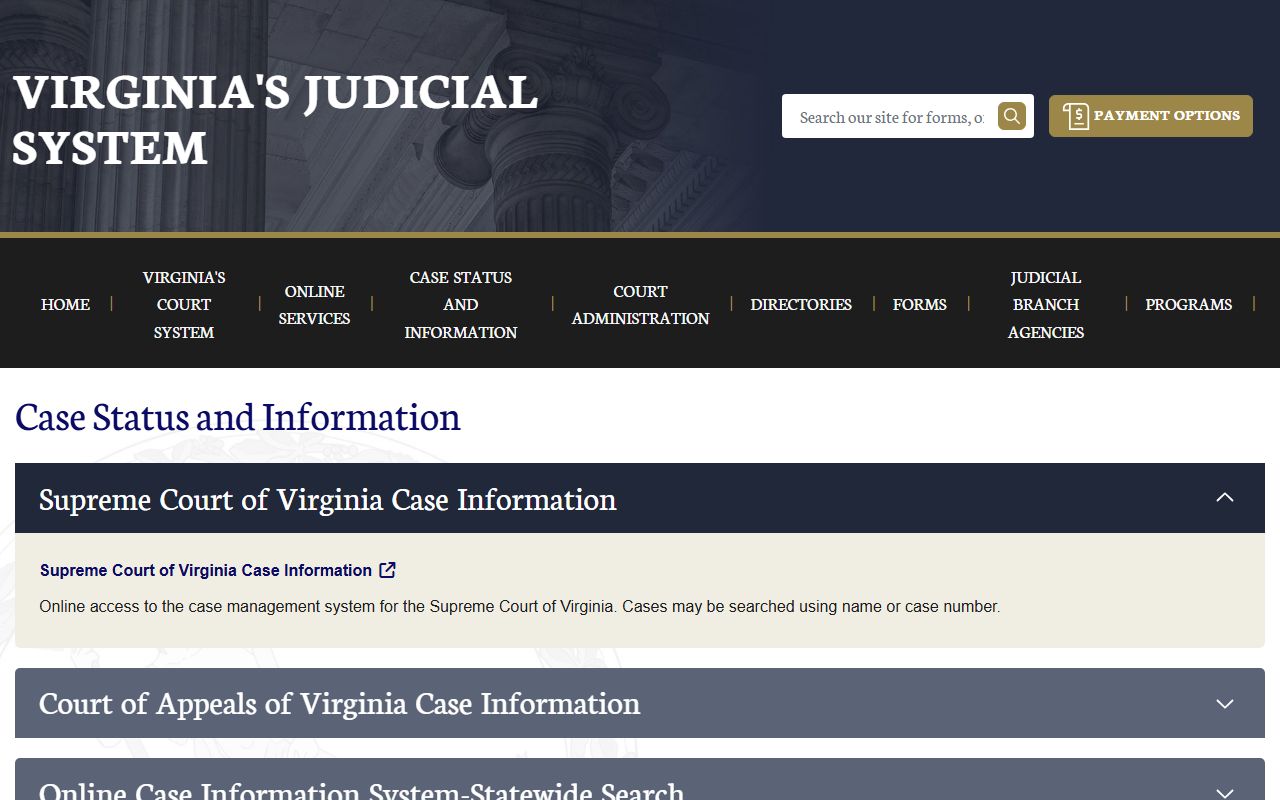
That statewide landing page matters because Gloucester arrest charges can appear in different court systems as the case moves from booking to hearings, transfer, indictment, or disposition.
| Court Search Channel | Best Use After Arrest | Research Notes |
|---|---|---|
| Virginia Courts Case Status and Information | Starting point for statewide, General District, Circuit, JDR, and payment links. | Official landing page for court case access systems. |
| OCIS Statewide Search | Broad criminal case lookup across supported Virginia courts. | Includes adult criminal/JDR, General District criminal and traffic, and select Circuit cases. |
| General District Court Case Information | Early misdemeanor, traffic-criminal, preliminary hearing, and felony-certification activity. | Research notes say searches may be by name, case number, or hearing date. |
| Circuit Court Case Information | Indicted felonies, appeals, and cases moved from lower court. | Gloucester Clerk gives the court-selection and Civil/Criminal workflow. |
Charging Documents After a Gloucester Arrest
A jail arrest usually starts with law-enforcement paperwork and intake. The court record starts taking shape when charges are placed before a court or later reviewed by the Commonwealth's Attorney. Gloucester research does not support promising a single charging-document path for every case. Some matters begin in lower court, some felony matters move through preliminary hearing and certification, and serious felonies may later appear in Circuit Court through indictment. The practical point is that a booking charge can be only the first version of the accusation.
| Document or Filing | Where It Fits | What to Check |
|---|---|---|
| Arrest warrant or summons-based charge | Often tied to the initial arrest, magistrate action, or lower-court case opening. | Name, charge wording, court, first hearing, bond, and any related warrant status. |
| Complaint or law-enforcement charge paperwork | Supports the arrest and booking path before formal court activity is fully reflected online. | Arrest date, arresting agency, case or incident number, and whether the court charge matches. |
| Felony certification or transfer | Moves a qualifying felony from lower-court screening toward Circuit Court activity. | Preliminary-hearing result, transferred charge, amended wording, and next court. |
| Indictment | Grand jury charging action for Circuit Court felony prosecution. | CR case number, indicted charge, prosecutor activity, hearing dates, and disposition. |
When records conflict, use the court case as the source for case status and disposition. Use the jail or sheriff record as the source for custody, intake, transfer, release, and records-request facts. A person can be arrested on one description, booked under another shorthand label, and prosecuted under an amended or indicted charge that reads differently.
Charge Status in Court Records After Arrest
Charge status is the most important part of a court-record search after a jail arrest. Gloucester research lists several common status terms used when a criminal case changes or resolves. A pending charge means the accusation is still active. A disposed case has reached a court action that resolved the case or charge. Dismissed and nolle prosequi are not the same word, but both can mean the charge did not continue to conviction. Amended or reduced charges show why the final court record may differ from the booking label.
| Status | What It Means | Why It Matters |
|---|---|---|
| Pending | The case or charge remains open. | Future hearings, bond conditions, and pretrial supervision may still control the person. |
| Disposed | The court has taken an action that resolved the case or charge. | The disposition must be read before assuming guilt, dismissal, or another outcome. |
| Dismissed | The charge ended without conviction. | It may still appear in public records unless sealed or expunged through the proper process. |
| Nolle prosequi | The prosecutor chose not to proceed on the charge. | Research notes that the Commonwealth's Attorney controls prosecution decisions after charges begin. |
| Amended or reduced | The charge changed from the original filing. | The final charge may be less serious, differently worded, or tied to a plea or court ruling. |
| Convicted or guilty | The court found guilt or accepted a guilty plea. | Sentencing, probation, jail time, fines, or later VADOC custody may follow. |
Bond, Pretrial Supervision, and Release After an Arrest
Virginia magistrates and courts make release and bond decisions after arrest. Gloucester's local pretrial source says Middle Peninsula Local Probation and Pretrial Services conducts background investigations on defendants arrested and booked into Middle Peninsula Regional Security Center or Gloucester County Jail. Those investigations help local courts make more informed bond decisions. Risk assessments are conducted on pretrial defendants to help determine bail and supervision level, and services can include alcohol and drug screening ordered as a pretrial bond condition.
Official Gloucester pages do not publish a complete bond-counter procedure, accepted payment methods, or bond-posting hours. The research-supported route is to confirm the person's location first, then ask the holding facility or court which office accepts bond, what payment forms are allowed, whether a surety bond is permitted, and whether a hold or detainer blocks release. If pretrial supervision is ordered, the Gloucester location for Middle Peninsula Local Probation and Pretrial Services is 7400 Justice Drive, Gloucester, VA 23061, phone 804-693-3088.
| Bond Type | How It Works |
|---|---|
| Personal recognizance or unsecured bond | Release may be based on a written promise to appear and obey court conditions, sometimes with supervision. |
| Secured or cash bond | Money or security must be posted before release when the court or magistrate requires it. |
| Surety bond | A licensed bail bondsman or surety may post bond for a fee under Virginia bonding rules. |
| Property bond | Real property may be used if accepted through the court or clerk process. |
| No-bond hold | No payment releases the person unless a court changes the order. |
| Detainer or hold | Another agency, probation/parole, DOC, federal, ICE, or another jurisdiction may prevent release. |
Warrants That Lead to an Arrest
No official Gloucester County active-warrant search or public warrant list was located on the sheriff site during research. The sheriff page does say communications personnel enter and maintain paperwork including protective orders, summonses, and arrest warrants, so the Sheriff's Office has a local records function. That does not create a public online warrant database. Treat warrant questions as a law-enforcement, court, or records-request issue.
For warrant-related court records after arrest, check the Virginia Courts systems for connected cases, capiases, bench warrants, summonses, and hearing history where publicly available. For existing sheriff records, FOIA requests may go through Jennifer Kurr, FOIA Officer, 7502 Justice Drive, Gloucester, VA 23061, phone 804-824-2715, subject to Virginia exemptions. For active safety issues, do not use a website search as a substitute for law enforcement or legal counsel.
Charges vs. Convictions
An arrest charge is an accusation. A conviction is a court outcome. Gloucester County court records after an arrest may list charges that are later dismissed, amended, nolle prossed, or reduced. Reading only the jail booking label can make a case look more final than it is. Reading only the final disposition can hide the fact that an earlier jail record used different language at intake.
| Charge | Conviction | |
|---|---|---|
| Stage | Accusation filed or pursued in court after arrest. | Verdict, plea, or finding that resolves guilt. |
| Proof level | May begin from probable cause or charging process. | Requires proof beyond a reasonable doubt or a valid plea. |
| Record meaning | Shows what was alleged and processed. | Shows a final guilt outcome and possible sentence. |
| Practical check | Look for amendments, dismissals, or nolle prosequi. | Read sentencing, probation, jail, or appeal details if available. |
Sealed vs. Expunged Arrest Records
Virginia expungement law may apply to qualifying police and court records after acquittal, nolle prosequi, dismissal, mistaken identity, absolute pardon, or other qualifying outcomes. Expungement is a court process. It is not the same as asking a private website to remove copied information, and it is not automatic just because a charge ended favorably. Gloucester records may also be restricted because of juvenile status, sealing, law-enforcement exemptions, or ongoing investigations.
| Sealed | Expunged | |
|---|---|---|
| Public visibility | Hidden from ordinary public access when a court or statute restricts the record. | Removed from public view through an expungement order for qualifying records. |
| Law-enforcement access | May remain available to authorized agencies under limited rules. | Access is restricted according to the court order and Virginia law. |
| Eligibility | Depends on record type, age, court order, or statutory restriction. | Virginia Code 19.2-392.2 and related provisions govern qualifying outcomes. |
| Where to start | Ask the clerk or an attorney what restriction applies. | Use the court process rather than a jail roster request. |
Background Check Considerations
Public court search tools are not the same as a compliant employment, housing, credit, insurance, or licensing background check. Criminal case records can be incomplete, delayed, amended, or restricted. A name search can also return multiple people or multiple case numbers. Anyone making a legally regulated decision must use the proper process and confirm identity through official channels.
Important: This site is not a consumer reporting agency and may not be used for any Fair Credit Reporting Act covered purpose.
Restricted Court Records After an Arrest in Gloucester County
Virginia law gives public access to many records, but not every arrest or court record is open online. Virginia FOIA's law-enforcement records section includes adult arrestee photographs and arrest or charge identity information, but release can be limited, including when disclosure would jeopardize a felony investigation. Virginia Code 2.2-3704.01 also supports redaction rather than withholding an entire public record when only part is excluded.
Juvenile cases, sealed charges, expunged records, some dismissed matters, sensitive victim information, and ongoing investigative records may be unavailable or partly redacted. For Gloucester Circuit records, the Clerk of Circuit Court is at 7400 Justice Drive, Suite 327, Gloucester, VA 23061, phone 804-693-2502. Office hours are Monday-Friday 8 a.m. to 4:30 p.m.; record-room hours are 8 a.m. to 4:15 p.m., and receipting ends earlier. The Commonwealth's Attorney is at 7400 Justice Drive, Room 230, Gloucester, VA 23061, phone 804-693-4995, fax 804-693-9425, Monday-Friday 8 a.m. to 4:30 p.m.